


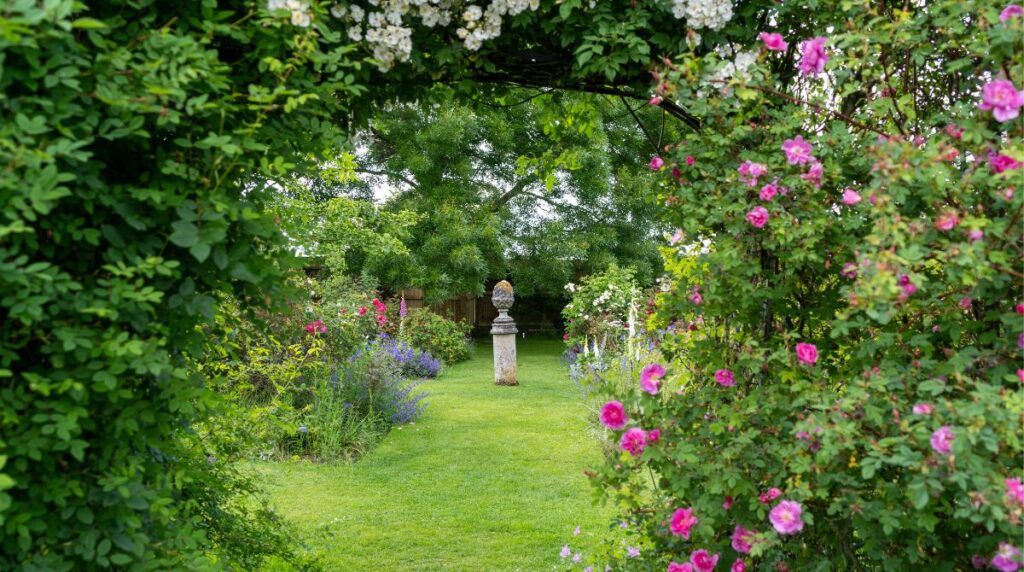
There is something undeniably romantic about the English country garden. It is an aesthetic defined by controlled chaos—a lush, overflowing tapestry of color, texture, and fragrance that seems to have grown up naturally over time.
At the heart of this iconic style lies the classic perennial border. Unlike modern, minimalist landscapes, the traditional English border is unapologetically full, layered, and teeming with life. Whether you are working with a sprawling estate or a small urban plot, you can capture this timeless look by choosing the right plants.
In this guide, we break down the essential plants you need to build your own flourishing English-style perennial border.
The Anchors: Structural Perennials
A successful border needs “backbone”—plants that provide height and structure to prevent the garden from looking like a flat patch of color.
- Delphiniums: These are the royalty of the English border. With their towering, spire-like blooms in shades of sapphire, violet, and white, they provide essential vertical interest.
- Digitalis (Foxglove): Perfect for the middle-to-back of your border. Their bell-shaped flowers add a whimsical, cottage-core charm and are a magnet for bumblebees.
- Hollyhocks (Alcea): These biennials are iconic. Plant them against a fence or wall to create a dramatic, old-world backdrop.
The Romantic Hearts: Must-Have Florals
The English garden is synonymous with soft, ruffled blooms and intoxicating scents. These plants provide the “froth” that softens the edges of your garden.
- Peonies (Paeonia): For early summer luxury, nothing beats the peony. Their lush, cabbage-like blooms offer a sense of opulence, and they return year after year with minimal fuss.
- English Roses (Rosa): No English garden is complete without roses. Choose varieties bred by David Austin for that classic, multi-petaled, high-fragrance look. Opt for shrub roses that blend seamlessly into the border rather than formal, stiff-stemmed varieties.
- Geraniums (Hardy varieties): Not to be confused with half-hardy pelargoniums, hardy geraniums (like Geranium ‘Rozanne’) are the ultimate “filler” plants. They weave through other plants, filling gaps with low-growing, long-lasting color.
The Texture Masters: Foliage and Grasses
A common mistake in beginner gardens is focusing only on flowers. To achieve the English look, you need to balance blooms with delicate foliage.
- Lady’s Mantle (Alchemilla mollis): With its chartreuse, frothy flowers and scalloped leaves that hold morning dew, this plant adds a luminous quality to the front of a border.
- Nepeta (Catmint): This provides a soft, cloud-like haze of lavender-blue flowers. It is drought-tolerant, long-blooming, and adds a romantic, “wild” texture to the border edges.
- Ornamental Grasses: Incorporating grasses like Stipa tenuissima (Mexican Feather Grass) adds movement. When the breeze catches them, they bring the garden to life, making it feel organic and airy.
The Pollinators: Essential Wildlife Magnets
English gardens are designed to be sanctuaries for wildlife. Integrating plants that attract bees and butterflies is crucial for both the ecosystem and the authentic aesthetic.
- Echinacea (Coneflower): These are sturdy, reliable, and provide a late-summer bridge as other flowers begin to fade.
- Salvia: Their deep, saturated colors provide a striking contrast to the softer pastels of roses and peonies. They are also incredibly resilient and loved by pollinators.
Tips for Designing Your Border
- Plant in Drifts: Avoid planting in straight lines. Plant in groups of three, five, or seven to create “drifts” of color that look more natural and meadow-like.
- Practice “Succession Planting”: Choose plants that bloom at different times—early, mid, and late summer—to ensure your border remains colorful from spring until the first frost.
- Embrace the “Cottage” Density: Don’t be afraid to plant closely. In a true English border, the plants should touch, effectively shading the soil and reducing the need for weeding.
Creating an English country garden is a marathon, not a sprint. It’s an exercise in patience and experimentation. Start with a foundation of reliable perennials, build in layers of height and texture, and don’t be afraid to let your garden “go loose.” After all, the beauty of the English border lies in its ability to look perfectly curated, yet wonderfully wild.
Ready to start planting? Grab your shovel, focus on your soil health, and get ready to transform your backyard into an English escape.