


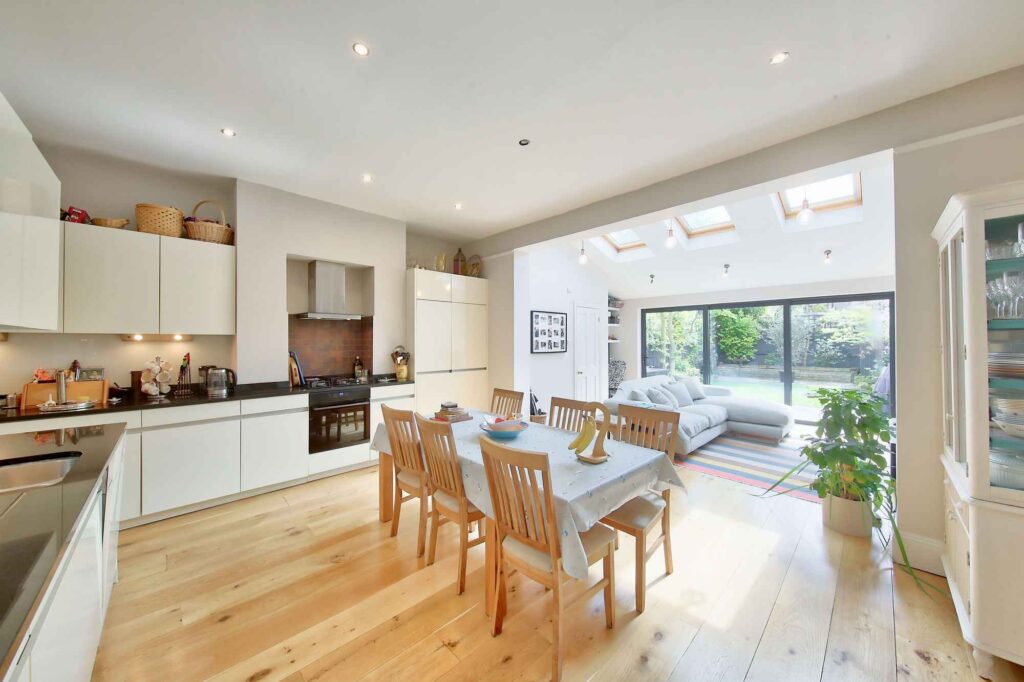
For the last two decades, the mantra of British home renovation has been “knock down the walls.” The vision was clear: a seamless, sun-drenched flow from the kitchen to the garden, perfect for socialising and keeping an eye on the kids. However, as our homes have become offices, gyms, and classrooms, a new contender has emerged.
The debate between Open Plan and Broken Plan is no longer just about aesthetics—it is about how we balance togetherness with the modern need for privacy.
The Classic: Open Plan Living
Open plan remains the gold standard for creating a sense of scale in smaller UK properties. By merging the kitchen, dining, and lounge areas into one “Great Room,” you maximise natural light and eliminate dark, dead-end hallways.
- The Appeal: It is inherently social. The person cooking dinner is no longer isolated in a separate room; they are part of the conversation.
- The Challenge: Acoustics and “visual noise.” In a completely open space, the roar of the extractor fan, the clatter of the dishwasher, and the sight of unwashed pans are constant companions to your evening relaxation.
The Challenger: Broken Plan Living
“Broken Plan” is the sophisticated middle ground. It retains the spacious, airy feel of an open layout but introduces subtle, structural “breaks” to define specific zones.
Instead of full-height stud walls, a broken plan uses:
- Internal Glazing (Crittall Style): Floor-to-ceiling glass partitions with black steel frames. This blocks sound and cooking smells while allowing light to flood through the entire floor.
- Half-Walls & Peninsula Units: A low-level wall can hide the “messy” kitchen counters from the sofa without closing off the room.
- Split Levels: Using two or three steps to separate the kitchen from a sunken “snug” creates a psychological boundary without needing a physical door.
- Double-Sided Fireplaces: A central fireplace acting as a pillar provides a focal point for both the dining and living areas while acting as a visual anchor.
Comparison: Which Suits Your Lifestyle?
| Feature | Open Plan | Broken Plan |
| Light Flow | Maximum; no barriers. | High; uses glass or low walls. |
| Acoustics | Poor; sound bounces easily. | Better; zones dampen noise. |
| Privacy | Minimal; shared space. | Moderate; offers quiet nooks. |
| Smell Control | Difficult to contain. | Easier with partial screens. |
| Heating | Can be costly to heat large volumes. | More efficient to zone heat. |
The “Work From Home” Factor
The shift toward “Broken Plan” was accelerated by the rise of remote work. A completely open plan is a nightmare for focus if someone else is watching TV or clattering in the kitchen.
A broken-plan layout allows for a “Library Nook” or a “Pocket Office”—a space that feels connected to the home’s energy but provides enough physical separation to indicate that “work is happening here.”
The Verdict: Designing for 2025
If you are working with a very small Victorian terrace, Open Plan is often the best way to avoid a claustrophobic feel. However, for larger family homes or extensions, Broken Plan is the future-proof choice. It offers the sociability we crave with the functional boundaries we actually need for a peaceful life.
Pro Tip: If you currently have an open-plan space and find it too noisy, you can “break” it without construction. Use open-backed shelving units as room dividers or place a large L-shaped sofa with its back to the kitchen to create a definitive “chill-out” zone.