
So, you’ve finally decided to invest in that dream log cabin. Whether it’s going to be a home office, a gym, a creative studio, or a backyard escape, you’re about to embark on an exciting project.
But before you start picking out paint colors and furniture, we need to talk about the most crucial part of the entire build: the base.
Many first-time buyers make the mistake of focusing entirely on the cabin itself, viewing the base as an afterthought. Here’s the golden rule of garden buildings: A log cabin is only as good as its base.
If your base is uneven, weak, or prone to holding water, your cabin will suffer. Doors and windows will warp and fail to close, timber will rot, and your warranty might even be voided.
To help you get it right, we’re breaking down the three most popular base options—Concrete, Paving Slabs, and Timber Decking—so you can decide which is best for your garden and your budget.
The Concrete Base: The Heavyweight Champion
If you want a base that will outlive the cabin itself, concrete is the undisputed king. It provides a completely solid, permanent, and perfectly flat foundation that distributes the weight of the cabin evenly.
Pros:
- Ultimate Strength: Concrete can support even the largest, heaviest multi-room log cabins with ease.
- Longevity: A properly laid concrete slab will last for decades without shifting or sinking.
- Moisture Barrier: When combined with a damp-proof membrane (DPM), it prevents rising damp from entering the cabin floor.
- Pest Control: It creates an impenetrable barrier against rodents and burrowing pests.
Cons:
- Labor-Intensive: Digging, mixing, pouring, and leveling concrete is hard physical work.
- Less Forgiving: If you mess up the levels or get it wrong, fixing cured concrete is a massive headache.
- Curing Time: You can’t build on concrete immediately; it typically takes a few days to set and up to 28 days to fully cure.
- Cost: It is generally more expensive upfront than paving slabs or timber framing.
Best for: Large log cabins (over 4×4 meters), cabins with heavy contents (like pool tables or heavy gym equipment), and sloping gardens where significant leveling is required.
Paving Slabs: The Versatile All-Rounder
Laying a base of paving slabs (or concrete flags) is a very popular middle-ground option for DIYers. It offers many of the structural benefits of concrete without the need to mix cement.
Pros:
- Easier for DIY: No mixing or pouring required. Slabs can be laid down piece by piece.
- Cost-Effective: Often cheaper than pouring a solid concrete slab, depending on the quality of the slabs you choose.
- Aesthetically Pleasing: If any paving extends beyond the footprint of the cabin, it creates a nice ready-made patio area or pathway around your building.
- Drainage: Unlike solid concrete, small gaps between slabs can sometimes allow for minor drainage (though a solid sub-base is still required).
Cons:
- Requires Precision: Getting every single slab level with its neighbor takes a lot of patience and tapping with a rubber mallet.
- Shift Risk: If the sub-base (the compacted hardcore beneath the slabs) isn’t done correctly, individual slabs can sink or lift over time under the heavy weight of a cabin.
- Weeds: Unless properly grouted or membrane-lined, weeds can occasionally pop up around the edges.
Best for: Medium-sized cabins, gardens with good existing drainage, and DIY enthusiasts who want a solid base without dealing with wet concrete.
Timber Decking / Framing: The Elevated Option
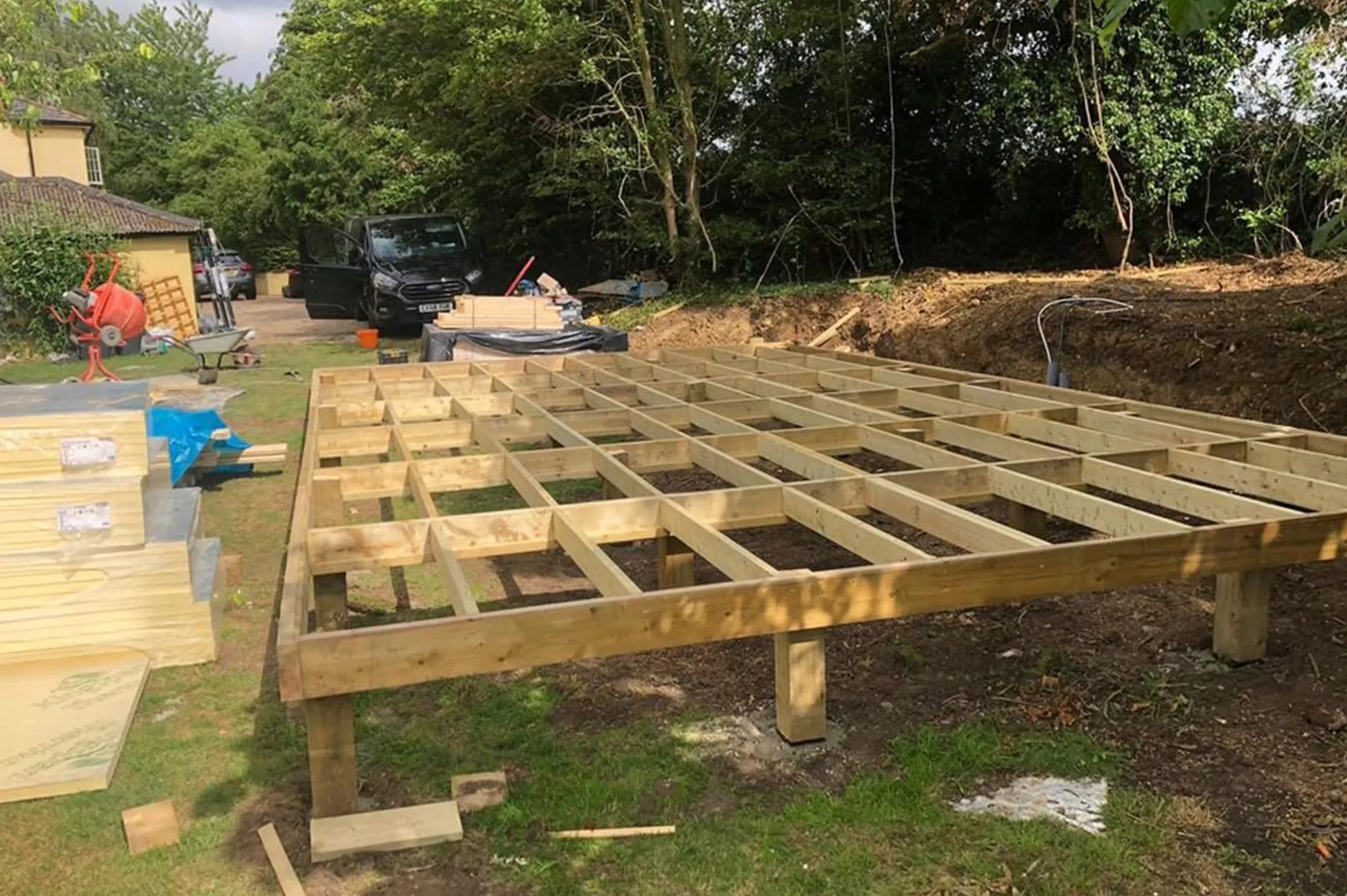
While traditional timber decking is sometimes used, when we talk about a “decking base” for a log cabin, we usually mean an engineered timber sub-base (often sitting on concrete pads or ground screws) or a raised wooden platform.
Pros:
- Great for Sloping Gardens: If your garden slopes dramatically, building a raised timber frame is often much easier and cheaper than trying to retain earth for a concrete pour.
- Airflow: Timber bases allow air to circulate freely underneath the cabin, which helps prevent moisture buildup.
- Speed: Once the materials are cut, a timber frame can be assembled very quickly.
- Natural Look: It blends seamlessly into a garden environment.
Cons:
- Lifespan: Wood is organic. Even with pressure-treated timber, a wooden base will eventually rot faster than concrete or stone.
- Weight Limits: Generally not suitable for exceptionally heavy cabins or heavy industrial use unless over-engineered with thick joists.
- Pest Potential: Unprotected spaces underneath decking can sometimes become nesting spots for local wildlife (like foxes, cats, or rodents).
Best for: Smaller to medium cabins, sloping or uneven gardens, and temporary or semi-permanent installations.
(Note: If you choose a timber frame, make sure you use pressure-treated C24 graded timber and a heavy-duty damp-proof membrane between the timber and the ground!)
Which Should You Choose?
To make your final decision, ask yourself three simple questions:
- How big is the cabin? (Go with Concrete for large, heavy builds; Paving or Decking are fine for smaller spaces).
- What is the lay of your land? (Flat gardens love Concrete or Paving; sloping gardens are usually best tackled with Timber/Decking or a stepped concrete form).
- What is your DIY skill level? (If you’ve never laid concrete before, Paving slabs on a well-compacted hardcore base might be your safest bet).
Whichever option you choose, remember the golden rule: Take your time getting the base level. Spend 80% of your prep time on the base, and the actual log cabin build will snap together like a dream.