
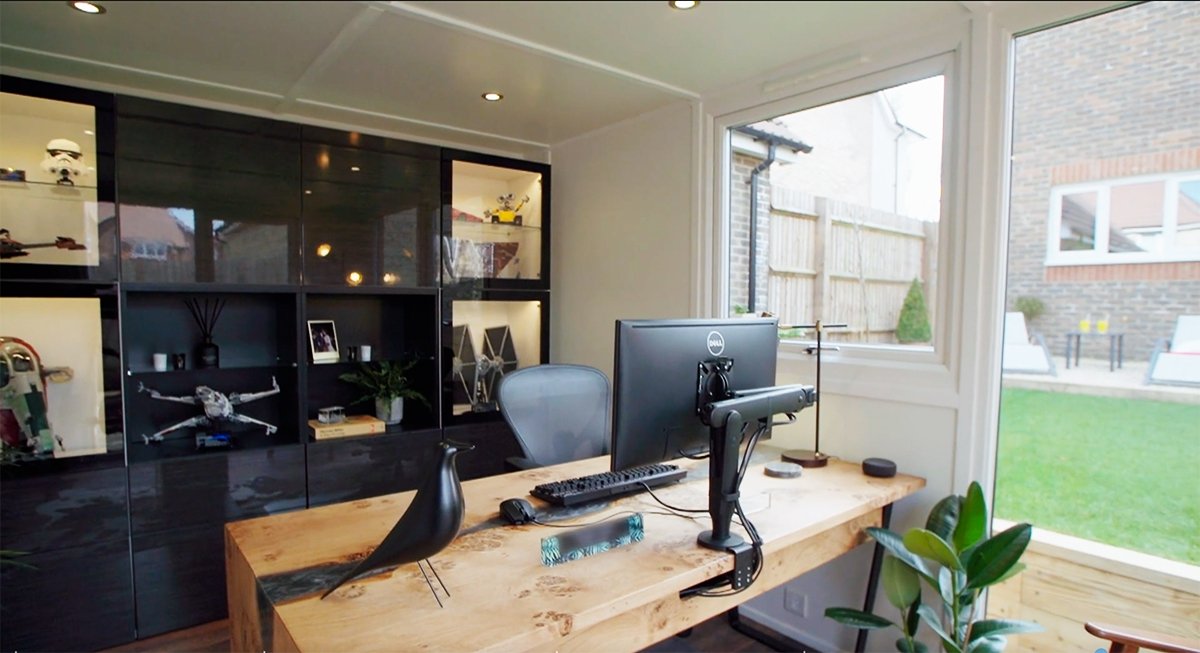
Working from home has become the new normal for many of us, but carving out a quiet, productive corner inside a busy house isn’t always easy. Enter the garden office: the ultimate backyard sanctuary.
However, when working with a compact footprint, every square inch counts. How do you fit a desk, storage, comfortable seating, and tech into a room that might only be 8×8 or 10×10 feet without it feeling like a broom closet?
The secret lies in smart interior design and intentional layouts. Here are some of our favorite space-maximising design ideas and layouts for a small garden office.
The Power of the Perimeter: The Wrap-Around Desk
In a small room, pushing furniture against the walls is rule number one. Instead of a traditional freestanding desk in the middle of the room, consider a custom wrap-around or L-shaped desk built into the corner.
Why it works: It leaves the center of the room completely open, creating a more expansive feel.
Design Tip: Use floating shelves above the desk to keep the floor clear. By keeping your monitors and laptops against the wall, you gain a massive amount of uninterrupted desktop space for writing, drawing, or spreading out blueprints.
The Window-Facing Setup (Embrace the View)
If your garden office has a view of greenery, capitalize on it! Position your primary desk directly facing the window.
Why it works: Looking at a horizon or nature tricks the brain into perceiving the room as larger than it actually is. Plus, natural light is a known productivity booster and reduces eye strain.
Design Tip: Keep window treatments minimal. Opt for sheer roller blinds or sleek Venetian blinds rather than heavy, sweeping drapes that eat up visual space on either side of the window.
Vertical Zoning (Look Up!)
When floor space is at a premium, the only way is up. Utilizing your vertical real estate is the number one way to prevent clutter from invading your workspace.
Why it works: Floor-to-ceiling storage draws the eye upward, emphasizing the height of the room rather than its compact width.
Design Tip: Install tall, narrow bookcases or floor-to-ceiling cabinetry on one accent wall. Use matching storage boxes or baskets to hide miscellaneous office supplies, maintaining a clean, minimalist aesthetic that keeps visual noise to a minimum.
Multifunctional & Fold-Away Furniture
If your garden office needs to pull double duty—perhaps as a yoga studio, a reading nook, or a guest bedroom on the weekends—modular furniture is your best friend.
Why it works: It allows you to transform the room based on your current activity, ensuring zero wasted space.
Design Tip: Invest in a wall-mounted fold-down desk that can be tucked away when the workday is done. Pair it with stackable stools that can slide right underneath, or a daybed with built-in drawer storage underneath for weekend lounging.
Color and Light Tricks
Interior design isn’t just about furniture placement; color and lighting play a massive role in spatial perception.
Monochromatic or Light Palettes: Paint the walls and ceiling the same shade of off-white, soft greige, or light pastel. Blurring the lines between the walls and ceiling makes the boundaries of the room recede.
Glass and Acrylic: Consider a glass-topped desk or a ghost chair (made of clear acrylic). Because you can see through them, they take up virtually zero visual weight in the room.
Layered Lighting: Avoid relying solely on a single central overhead light, which can cast harsh shadows and shrink the room. Instead, use a mix of task lighting (a sleek desk lamp), accent lighting (LED strip lights under floating shelves), and wall sconces.
Keep the Floor Clear
Nothing makes a small room feel smaller than a cluttered floor.
Why it works: The more bare flooring you can see, the larger the room will feel.
Design Tip: Choose furniture with exposed legs (mid-century modern style desks and chairs work wonderfully) rather than bulky furniture that sits flat on the floor. Furthermore, use wireless tech accessories, and run power cords through integrated desk grommets or wall channels to keep unsightly cables out of sight.
A small garden office doesn’t mean compromising on comfort or style. By adopting a “less is more” mindset, embracing vertical storage, and choosing multi-functional layouts, you can turn even the most compact shed or pod into a spacious, inspiring hub of productivity.