
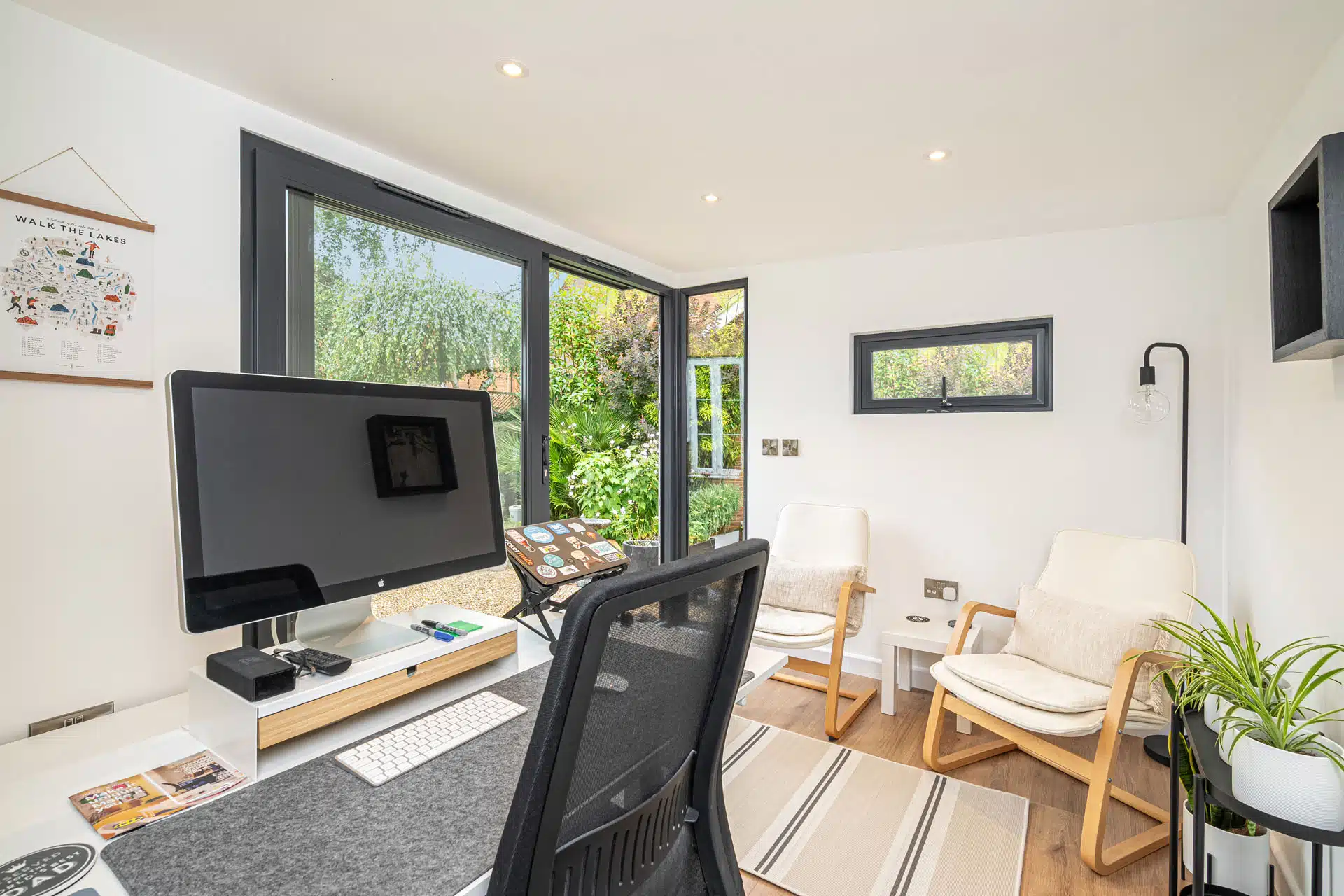
Working from home has gone from a temporary perk to a permanent way of life for millions of us. But let’s be honest: sitting at the dining table with the kids running around or trying to look professional on a Zoom call with your laundry in the background isn’t ideal.
Enter the garden office. It’s the ultimate solution—a commute of just ten steps, a clear boundary between work and home, and a lovely view of the hydrangeas.
Before you start browsing sleek wooden pods and ergonomic chairs, however, there is one crucial question you need to answer: Do I need planning permission?
The short answer is: Usually, no. Thanks to “Permitted Development Rights,” most garden offices can be built without getting formal approval from your local council.
However, there are strict rules you must follow. Break just one, and you could face the dreaded knock on the door from the local planning officer, or worse, orders to tear your shiny new workspace down.
Here is everything you need to know to make sure your garden office stays firmly on the right side of the law.
Understanding “Permitted Development”
In the UK, Permitted Development (PD) allows homeowners to carry out certain types of work without needing to apply for full planning permission. Garden offices fall under the category of “outbuildings.”
To qualify for Permitted Development, your garden office must meet all of the following criteria:
Height Matters (Watch the Roof)
- If your office has a dual-pitch roof (like a traditional house roof), the maximum overall height cannot exceed 4 metres.
- If it has a flat roof or a single-pitch roof, the maximum height is restricted to 3 metres.
Crucial catch: If your garden office is positioned within 2 metres of your property boundary, the maximum overall height for any roof type is strictly 2.5 metres.
Size and Coverage
Outbuildings cannot take up more than 50% of the total land area surrounding the “original house” (as it was first built, or as it stood on July 1, 1948). This includes extensions, sheds, and greenhouses, but not the house itself.
Location on Your Plot
Your garden office must be behind the principal elevation (the front) of your house. You cannot build a garden office in your front garden without planning permission.
If you live in a conservation area, a National Park, an Area of Outstanding Natural Beauty, or a World Heritage Site, permitted development rights are much tighter. You generally cannot place an outbuilding to the side of your house in these areas, and any building more than 20 metres from the house requires specific permissions.
Verandas, Balconies, and Raised Platforms
If your design includes a raised platform, veranda, or balcony, it can only be permitted if the floor is no higher than 300mm off the ground. If you want a lovely raised deck to sip your morning coffee on, keep it low!
Sleeping Accommodation
A garden office is for working (or relaxing). You cannot use a standard permitted-development garden office as self-contained living accommodation or somewhere for guests to sleep overnight. If it includes a bed, toilet, and kitchen facilities, it crosses the line into a separate dwelling and will almost certainly require planning permission.
What About Building Regulations?
Planning permission and Building Regulations are two completely different things, and people often confuse them.
Even if you don’t need planning permission, you may still need to comply with Building Regulations.
Under 15 square metres: Generally, a small garden office with a floor area of less than 15 sq. metres (and no sleeping accommodation) will not need Building Regulations approval.
Between 15 and 30 square metres: You usually won’t need Building Regulations approval as long as the building contains no sleeping accommodation AND is either at least 1 metre away from any boundary or is constructed substantially of non-combustible materials.
Over 30 square metres: If you are building a palace of a home office exceeding 30 sq. metres, you will almost certainly need to comply with Building Regulations, particularly regarding structural integrity, electrical safety, and thermal insulation.
Note: If you plan to run mains electricity, water, or drainage to your office, the installation work itself will need to comply with Building Regulations (e.g., Part P for electrical work).
Special Cases: When Do You Definitely Need Permission?
You will need to submit a planning application if:
- You live in a listed building.
- Your local authority has removed Permitted Development rights via an Article 4 Direction (common in conservation areas or specific housing estates).
- You want to run a business from the office that involves frequent visits from members of the public or clients, or if it will cause a nuisance to neighbors (e.g., excessive noise, heavy traffic, or lots of parking). Standard desk work usually doesn’t count, but a beauty salon or dog-grooming parlor might.
Peace of Mind: The Lawful Development Certificate
If you’ve checked all the boxes and are 95% sure your garden office falls under Permitted Development, you can just go ahead and build it.
However, many homeowners choose to apply for a Lawful Development Certificate (LDC) from their local council before starting work. This is a formal legal document confirming that your build is legal. It costs a fee, but it’s invaluable if you ever decide to sell your house, as it proves to skeptical buyers (and their solicitors) that your garden office was built above board.
The Golden Rule: Talk to Your Neighbours
Legalities aside, the best way to avoid planning nightmares is to chat with your neighbors. If your garden office is going to loom over their fence, tell them about your plans in advance. Show them the dimensions and reassure them it’s just a quiet workspace. A little neighborly courtesy goes a long way and prevents petty complaints to the local council.
Summary Checklist
Is it behind the front line of the house?
Is it under 2.5m high (if within 2m of a boundary)?
Does it take up less than 50% of your garden space?
Does it have no raised decking over 300mm?
Is it strictly for working/relaxing, not sleeping?
Are you not in a conservation area or listed building?
If you ticked every box, you’re good to go! Time to start shopping for that standing desk.
(Disclaimer: Planning rules can occasionally change and are subject to local council interpretation. It is always best to double-check with your local planning authority or consult with your garden office supplier before parting with your money.)