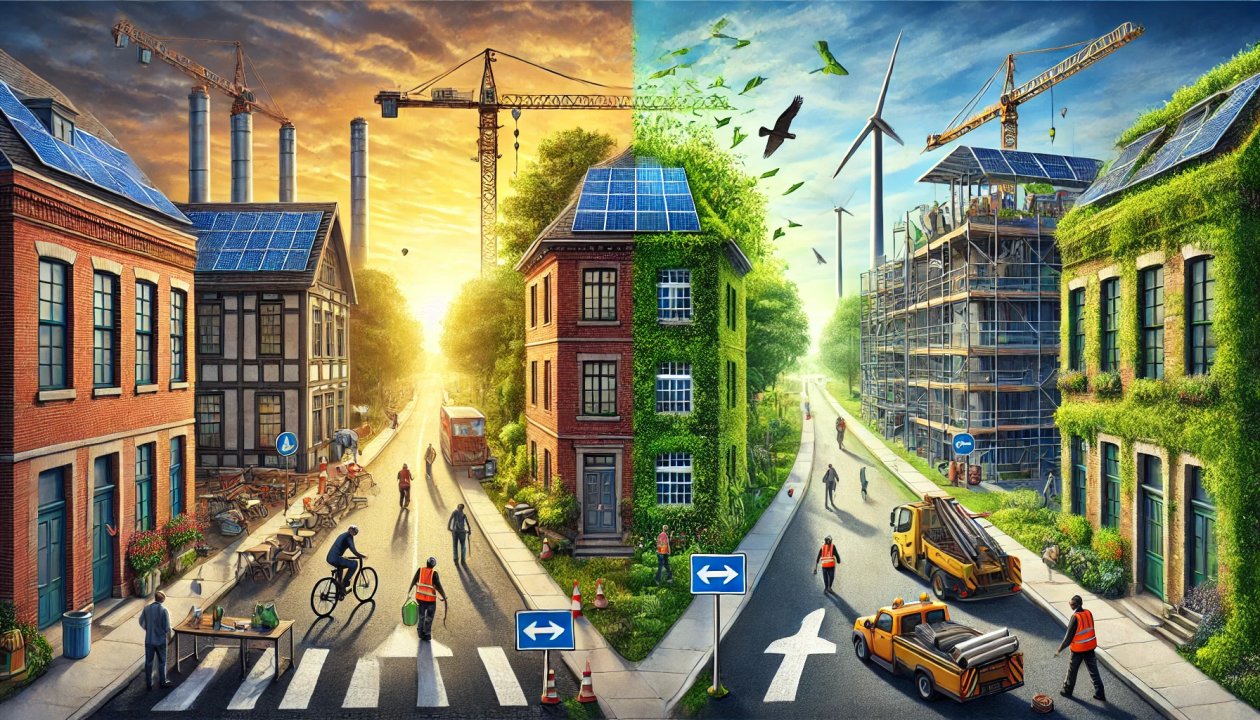
“The most sustainable building isn’t the one that never changes—it’s the one that adapts intelligently.”
When a structure reaches the end of its useful life, owners, architects, and policymakers face a pivotal decision: retrofit the existing building or rebuild from the ground up. Both options promise modern performance, but which one truly delivers on the promise of sustainability?
In this post we’ll unpack the environmental, economic, and social dimensions of each approach, walk through real‑world case studies, and give you a decision‑making framework you can apply to any project.
1. Defining the Two Strategies
Retrofit Rebuild What it is Upgrading an existing structure—adding insulation, modern HVAC, renewable energy systems, or re‑configuring spaces—to meet current performance standards. Typical Scope Partial or whole‑building interventions (e.g., façade upgrades, lighting retrofits, plug‑and‑play solar kits). Timeframe Months to a few years, depending on complexity. Capital Outlay Usually lower upfront cost, though life‑cycle costs can vary. 2. The Sustainability Lens: What Does “More Sustainable” Mean?
Sustainability isn’t a single number; it’s a triple‑bottom‑line evaluation:
Dimension Key Metrics Environmental Embodied carbon, operational carbon, waste generation, material toxicity, water use. Economic Life‑cycle cost (LCC), return on investment (ROI), job creation, asset value. Social Community disruption, heritage preservation, occupant health, accessibility. A truly sustainable decision balances all three. Let’s see how retrofitting and rebuilding stack up.
3. Environmental Impact
3.1 Embodied Carbon
- Retrofit: Keeps the existing structural “skeleton” (concrete, steel, timber) in place, avoiding the massive emissions tied to producing new materials. Studies from the World Green Building Council show that up to 70 % of a building’s total carbon footprint is embodied—so preserving that mass can be a huge win.
- Rebuild: Demolition generates 0.5–2 tCO₂e per m³ of concrete, and new construction adds fresh embodied carbon from cement, steel, and insulation. Even a high‑performance new building often carries a carbon debt that can take 10–30 years of operation to “pay back.”
3.2 Operational Carbon
- Retrofit: Modern HVAC, LED lighting, and building automation can slash energy use by 30‑60 % in older stock. Adding rooftop solar or on‑site storage further reduces grid dependence.
- Rebuild: A purpose‑built net‑zero or passive house can achieve near‑zero operational energy, but only after the upfront embodied carbon is amortized.
3.3 Waste & Circularity
- Retrofit: Generates far less construction waste—mainly demolition debris from targeted areas. Materials that are removed (e.g., outdated windows) can often be re‑purposed or recycled.
- Rebuild: Full demolition produces 5–15 t of waste per m² of floor area, much of which ends up in landfills unless a rigorous deconstruction plan is in place.
Bottom Line (Environmental)
If the existing building’s structural integrity and layout are sound, retrofitting usually wins on embodied carbon and waste reduction. Rebuilding only overtakes retrofit when the current building is severely inefficient, contaminated, or physically compromised (e.g., seismic retrofits in quake zones).
4. Economic Realities
Factor Retrofit Rebuild Initial Capital 40‑70 % of rebuild cost (depends on scope). 100 %+ of project budget. Payback Period 5‑12 years for energy‑saving upgrades (varies by climate, incentives). 10‑25 years to recover embodied‑carbon debt plus construction cost. Financing Incentives Many jurisdictions offer tax credits, utility rebates, and low‑interest green loans for retrofits. Incentives exist, but they often target new construction; the net benefit may be lower after accounting for demolition costs. Asset Value Upgraded historic or iconic buildings can command premium rents and resale values. New builds can achieve higher initial rents, but depreciation accelerates once the building ages. Job Creation Labor‑intensive, localized work—often creates more jobs per dollar spent. Large contractor bids; more “off‑site” prefabrication reduces on‑site labor. Takeaway: From a pure cash‑flow perspective, retrofitting is usually the more economical route, especially when you factor in green financing and reduced demolition fees.
5. Social & Community Considerations
Aspect Retrofit Rebuild Disruption Targeted zones → less impact on occupants and neighbours. Full site closure → weeks of noise, dust, traffic changes. Heritage & Identity Preserves cultural landmarks, street‑level character, and community memory. Risks erasing architectural heritage, which can weaken place‑based identity. Occupant Health Upgraded ventilation, daylighting, and low‑VOC finishes improve indoor air quality. New builds can be designed for optimal health, but the demolition phase can temporarily degrade air quality. Equity Renovation often aligns with affordable‑housing goals, keeping existing residents in place. New construction can trigger gentrification, displacement, or loss of affordable units. Bottom Line: Retrofitting generally scores higher on social sustainability, especially in dense urban cores where community continuity matters.
6. Decision‑Making Framework
Below is a simple checklist you can walk through with your project team:
Question If “Yes,” Lean Toward… Is the existing structural system sound (no major cracking, foundation issues)? Retrofit Does the building have historic or cultural significance? Retrofit Can you achieve a ≥30 % reduction in operational energy with upgrades? Retrofit Are demolition and new‑construction permits more costly or restricted? Retrofit Is the building severely contaminated (asbestos, lead, mold) requiring full removal? Rebuild Does the site have excessive land‑to‑floor‑area ratio that can be better utilized with a larger footprint? Rebuild Are you targeting net‑zero operational energy and can offset the embodied carbon debt within 5 years? Rebuild (only if you can procure carbon‑negative materials). Is there a strong market demand for a new‑type building (e.g., mixed‑use, high‑rise) that the existing footprint cannot accommodate? Rebuild If most answers point to retrofit, you’ve likely found the greener path. If several “no” answers dominate, a rebuild may be justified—but be prepared to mitigate embodied carbon through deconstruction, material reuse, and carbon‑offset strategies.
7. Real‑World Illustrations
7.1 The Empire State Building – “The Power of Retrofit”
- Scope: 2010‑2014 energy‑efficiency overhaul (window upgrades, chiller plant replacement, LED lighting).
- Results: 38 % reduction in electricity use, saving ~4.4 M tCO₂e over 15 years.
- Why it mattered: The building’s iconic steel frame remained untouched, preserving 90 % of its embodied carbon.
7.2 The 555 West 71 Building – “When Rebuild Wins”
- Scope: A 1960s office tower in Denver was demolished due to seismic code deficiencies and severe asbestos contamination.
- Outcome: New high‑rise built to LEED‑Platinum with a fully modular façade, achieving net‑zero operational energy.
- Why it mattered: The original building’s structural deficiencies made retrofitting unsafe and prohibitively expensive; the new design delivered a 10‑year carbon payback thanks to carbon‑negative concrete and on‑site renewable generation.
7.3 Small‑Scale Example: A 1970s Mid‑Rise in Portland, OR
- Retrofit package: Added exterior insulation, high‑performance windows, and a heat‑pump system.
- Cost: $150 k (≈ $30 / ft²).
- Payback: 8 years, with a 50 % reduction in annual energy bills.
- Social win: Tenants remained in place; the building retained its historic brick façade.
8. Emerging Technologies That Blur the Line
Technology How It Shifts the Balance Carbon‑Negative Concrete (e.g., Bio‑Cement) Lowers the embodied carbon of new construction, making rebuilds more competitive when demolition is unavoidable. Modular & Prefabricated Systems Reduce on‑site waste and construction time, shrinking the carbon debt of new builds. Digital Twins & AI‑Driven Energy Modeling Provide precise retrofit ROI predictions, revealing hidden savings that tip the scales toward renovation. Circular Deconstruction Platforms Allow selective demolition and material reuse at scale, mitigating the waste penalty of rebuilds. These tools are making both pathways greener, but they also highlight that the “right” choice is context‑specific, not universal.
9. The Verdict: Which Is More Sustainable?
Short answer: If the building’s structure, location, and future program can accommodate upgrades, retrofitting is generally the more sustainable option.
Long answer: Sustainability is a spectrum. A retrofit that merely paints over old windows may look inexpensive but could lock in high operational emissions for decades. Conversely, a rebuild that employs carbon‑negative materials, full‑site deconstruction, and net‑zero design can be justified when the existing building is a carbon sink (e.g., hazardous, structurally unsound, or grossly inefficient).
Bottom line: Use the triple‑bottom‑line checklist above, factor in emerging low‑carbon construction tech, and let the life‑cycle carbon balance guide you. When in doubt, run a life‑cycle assessment (LCA)—the numbers rarely lie.
10. Take Action Today
- Audit your portfolio. Identify high‑energy, high‑embodied‑carbon assets.
- Run a quick LCA. Many SaaS platforms (e.g., One Click LCA, Athena Impact Estimator) let you compare retrofit vs. rebuild in minutes.
- Secure financing. Look into local green bonds, ENERGY STAR rebates, or the U.S. Federal Investment Tax Credit (ITC) for solar‑plus‑storage retrofits.
- Engage stakeholders early. Residents, heritage groups, and local officials can be powerful allies for a retrofit narrative.
- Plan for the future. Design retrofits with a “future‑proof” mindset—install conduit for later EV charging, add adaptable floor plates, and choose materials that can be easily reclaimed.
TL;DR
- Retrofit = lower embodied carbon, less waste, cheaper, socially friendly—ideal when the building’s skeleton is still solid.
- Rebuild = opportunities for net‑zero design, better site utilization, but higher embodied carbon and cost—only justified when the existing structure can’t meet safety, health, or performance thresholds.
In the quest for a climate‑neutral built environment, the smartest sustainability strategy is the one that keeps the most material in the ground while delivering the lowest total carbon over the building’s remaining life. More often than not, that strategy is retrofit—but never assume; always calculate.
Happy building, and may your projects tread lightly on the planet!
Retrofitting vs. Rebuilding: Which Path Is Truly Sustainable?